 Culture
Kebbock: The Scots Word for Cheese That Carries a Nation's Food History
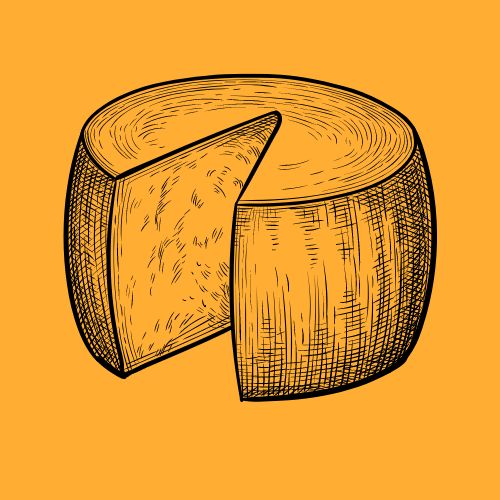
There's a Scots word — kebbock — that means cheese. Not a specific kind of cheese. Just cheese. A whole wheel of it, made in someone's home, stored in a wicker basket called a kebbock-creel, eventually whittled down to its last hard stub, the kebbock-heel.
It's a word that carries centuries of Scottish food history inside it. It shows up in the oldest Scottish poetry. Robert Burns put it in his most famous domestic poem. When farmhouse cheesemaking in Scotland was nearly wiped out, the tradition the word described almost vanished with it. And today, there's a modern farmhouse cheese in Lanarkshire that takes the old name as its own.
This is the story of a word — and what it tells us about a country's relationship with cheese.
Where the Word Comes From
Kebbock — also spelled kebbuck, kebuck, kebback, kibbock, and half a dozen other ways across the centuries — appears in Scots records from around 1470. It meant, simply, a farmhouse cheese. A whole one. What you'd make at home, salt in the dairy, press in cloth, and store for the winter.
The etymology is genuinely contested. The word has been compared with Scottish Gaelic càbag, which also means a wheel of cheese — but that form only appears in Gaelic texts from the 18th century, roughly three hundred years after kebbock is documented in Scots. The scholarly consensus leans toward the Gaelic borrowing from Scots, not the other way around.
Follow the roots further and you get ceapag, a Gaelic dialect word for "a round lump, as of cheese," which is a diminutive of ceap — a block, a stock, the thick wooden wheel of a wheelbarrow. From Middle Irish cep, probably from Latin cippus (a wooden stake or post). So at the far end of the chain: kebbock, the Scottish word for a farmhouse cheese, may trace back to the Latin for a fence post — because both are solid, round, and hold things together.
Whether or not that etymology holds, the shape makes sense. A kebbock is a block. You cut it in slabs.
There's even a Scottish proverb about it: "A whang aff a new cut kebbuck is ne'er missed" — a slice off a newly cut cheese is never missed. It's a saying about generosity, about abundance, about how easy it is to give when you have plenty.
A Word in Good Company
The reason we know kebbock was in common use isn't just the dictionary. It's the literature.
Robert Henryson, the 15th-century Scottish poet, used a variant of the word in The Fox, the Wolf and the Cadger, one of his Morall Fabillis. The fox tricks a wolf by describing a summer cheese, "fresche and fair", to lure him into misadventure. A cabok — an early form of kebbock — sits at the center of the deception. This is the earliest recorded use. The cheese, as always, is the thing everyone wants.
Robert Burns used it twice. In The Cotter's Saturday Night (1786), the cotter's wife brings out "her weel-hain'd kebbuck, fell" — her well-kept, carefully preserved cheese — to honor a guest at the supper table. She's kept it for exactly this moment. The poem tells us it's been a full year since the flax was in bloom when the cheese was made. That weel-hain'd (well-hoarded) quality is everything: the kebbock was not for every day. It was laid away. It was brought out when company came.
In The Holy Fair, Burns makes a more cutting joke — "An' dinna for a kebbuck-heel, Let lasses be affronted" — using the kebbock-heel, that hard last remnant of the wheel, as a symbol of something trivial not worth losing dignity over.
James Hogg, the Ettrick Shepherd, gave us another picture in The Shepherd's Calendar: a young farmer tasting "Old Janet's best kebbuck, and oatmeal cakes" before setting out through snow. Cheese and oatcakes. The two were inseparable.
Together, these references sketch a portrait of the kebbock in Scottish rural life: it was domestic, seasonal, a marker of care and thrift, present at the table when life was good, made by women, kept by women, brought out with ceremony.
Scottish Cheese Was Always Different
To understand why kebbock matters, you have to understand how Scotland's cheese tradition differed from England's.
The Romans invaded England and Wales and brought with them a whole technology of cheesemaking — rennet-set curds, pressed cheeses, the hard styles that eventually became Cheshire, Gloucester, Stilton, Cheddar. Scotland was never invaded. The Romans built a wall and stopped.
What Scotland kept was its Celtic dairy tradition: acidic cheeses, lactic cheeses, made by souring the milk rather than adding rennet. Crowdie — a soft, fresh curd cheese made by crofters across the Highlands and Islands — is probably Scotland's oldest surviving cheese. Its origins are genuinely debated between the Pictish era and the Viking settlement of the coasts; either way, it predates written record. The method is simple: let the milk sour, cook it until it curdles, drain through cloth, add salt and a little cream. The result is white, fresh, slightly lemony, and perishable.
Caboc is even older in legend. Made from double cream rather than whole milk — all the fat skimmed off and acidified, then shaped into logs and rolled in toasted pinhead oatmeal — it's attributed to Mariota de Ile, daughter of a Clan MacDonald chieftain, sometime in the 15th century. The story goes that Mariota, threatened by Clan Campbell, fled to Ireland where she learned to make cheese, then passed the recipe to her daughter, who passed it to hers. The cheese traveled through women's hands, generation by generation, until it nearly vanished.
What Scotland mostly did not have, for most of its history, was the hard pressed cheese that England became famous for. The kebbock was a farmhouse thing — made by the wife, stored in a creel, eaten young or aged for the winter. Not traded, not exported, not particularly consistent from farm to farm.
That changed dramatically at the turn of the 18th century, when one woman from Ayrshire rewrote the tradition.
Barbara Gilmour and the Cheese That Nearly Got Her Burned
Barbara Gilmour was a Covenanter — a Scottish Protestant who refused to renounce her faith during the religious conflicts of the 1680s. When the persecutions intensified, she fled to County Down in Ireland, where she found work and, crucially, learned a new way to make cheese: from whole, unskimmed milk rather than the skimmed milk Scottish farmwives had always used.
She came back to Scotland after the Revolution of 1688 and began making cheese on her farm at Dunlop, in Ayrshire. The result — pale, mild, buttery, and rich from the fat she'd stopped throwing away — was unlike anything her neighbours had tasted. Some of them, convinced that cheese could not possibly be made from whole milk, came close to accusing her of witchcraft.
She wasn't burned. The cheese spread instead.
Dunlop cheese became the definitive Scottish kebbock of the 18th and 19th centuries. By 1837, the parish of Dunlop alone was producing 25,000 stones of it annually. Cadgers — middlemen who toured the farms buying cheeses by direct negotiation — sent them by cart to Glasgow, Edinburgh, and London. Ayrshire became so famous for cheese production that it picked up a nickname: Kebbock-shire.
William Cobbett, touring Scotland, called Dunlop cheese equal in quality to anything from Cheshire, Gloucestershire, or Wiltshire. This was high praise from an Englishman.
The Near-Death of Scottish Cheese
The 20th century nearly killed all of it.
Two wars, rationing, and the Scottish Milk Marketing Board combined to dismantle Scottish farmhouse cheesemaking. The Board made it economically irrational for farms to keep making cheese — better to sell the milk at guaranteed prices than to take the labour and risk of turning it into something more complex. By 1972, the Scottish Farmhouse Cheese-makers Trophy was discontinued. There had been only one entrant in six years. He stopped making cheese in 1974.
The entire tradition of the kebbock — the farmhouse wheel, made by hand, stored through winter, brought out for guests — had been reduced to a single lonely competition with no competitors.
The only Scottish cheeses that survived through this period were Crowdie and Caboc, both kept alive in a small dairy in Tain, Ross-shire. Susannah Stone had started making Crowdie in 1967 after her husband Reggie complained one day that nobody made it anymore. She soured a ten-gallon churn of milk in the family bath. It was good enough that a local grocer bought the surplus. That small stubborn act of domestic cheese-making — almost exactly the same tradition the word kebbock had always described — kept a thread of continuity alive through the darkest period.
The Revival
The 1980s brought the reversal. A few Scottish farmers went back to making cheese, and one in particular changed what Scottish artisan cheese could be.
Humphrey Errington bought a farm at Carnwath in Lanarkshire in 1981 and began making raw milk cheese a few years later. His first creation, in 1985, was Lanark Blue — a sheep's milk blue made with Lacaune ewes (the same breed used for Roquefort), the first blue ewe's milk cheese made in Britain since the Middle Ages. It was extraordinary. It was also controversial: in 1994, Scottish health authorities seized his entire stock over a Listeria scare, with national newspapers calling it "Killer Cheese." His own tests found nothing. Buyers retested. Nothing. The cheese was eventually cleared.
He kept going. And at some point, to please his mother-in-law Maisie — who didn't like blue cheese — he made a different cheese entirely. Cloth-wrapped, unpressed, aged 2–5 months, sharply lactic with a hint of turnip and a finish that pairs perfectly with whisky.
He called it Maisie's Kebbuck.
The name is both literal and deliberate. A kebbuck is a cheese. This is Maisie's cheese. But it's also a small act of historical reconnection — reaching back to the word that Scottish farmwives used for centuries to describe what they made in their dairies, and giving it back to a modern farmhouse cheese.
The Cheese That Lives On
Scottish artisan cheese has continued to grow since Errington broke ground. There are now dozens of producers making cheeses that would have been unrecognizable to earlier generations of Scottish dairyfolk — and others that would feel entirely familiar.
Highland Fine Cheeses in Tain (the same family that kept Crowdie alive) now makes Strathdon Blue, Minger (a washed-rind Reblochon-style), and a full family of traditional styles. Isle of Mull Cheddar, made by the Reade family at Sgriob-ruadh farm using fermented grain from the Tobermory distillery, has become one of Britain's most celebrated farmhouse cheddars. St Andrews Farmhouse Cheese, made by Jane Stewart in Fife from her own herd's unpasteurised milk, produces an Anster that's on Slow Food's Ark of Taste. Connage Highland Dairy makes Dunlop — the same cheese Barbara Gilmour brought back from Ireland three centuries ago — from their organic herd grazing the shores of the Moray Firth. Loch Arthur, a Camphill Community in Dumfriesshire, has been making biodynamic organic farmhouse cheese since 1985, with 14 cows and a commitment to methods that would have been recognizable to any kebbock-maker of the 17th century.
The Ethical Dairy at Rainton Farm in Galloway — where calves are kept with their mothers to suckle naturally — restarted cheesemaking on the farm in 2013 after a forty-year gap. They named one of their cheeses Rainton Tomme, but the spirit behind it is ancient.
A Word That Survived
Kebbock is still in the Scottish National Dictionary. It is still used, occasionally, in the parts of Scotland where old Scots words persist. It has its related terms — the kebbock-heel you scrape into soup, the kebbock-creel you store it in, the Kebbock-shire that built a regional identity around making it.
It encodes a whole world: farmwives scouring the cream, monks bringing recipes from the Continent, religious exiles returning with new techniques, cadgers rattling across the glens, Burns's cotter's wife bringing out the good cheese for company, Susannah Stone souring milk in her bath while the tradition teetered on the edge of disappearance.
The word is a wheel of cheese. Cut yourself a whang. It will not be missed.
Find Scottish artisan cheeses through the Fine Cheesemakers of Scotland, or look for Maisie's Kebbuck and Lanark Blue from Errington Cheese.